
MOVIE OF THE MONTH
FEB ‘26
MOVIE OF THE MONTH
FEB ‘26

LOGAN’S RUN
Directed by Michael Anderson | 1976 | 118 min
“OVERWHELMING, AM I NOT?”
I was twelve years old when I first came across Logan’s Run. At the time, movies weren’t of much interest to me; I spent most of my free time doodling cartoons and illustrating my own comics. Of these, my favorite to draw were the misadventures of Major Tom, named after David Bowie’s character from the song “Space Oddity.” Only, my version of the character had terribly little to do with Bowie’s and was really a thinly veiled rip-off of Futurama’s Zapp Brannigan. In one particular installment—where Tom attended a costume party—I needed to find the perfect outfit for him. It had to be some obscure nod to science fiction, exactly the kind of thing my version of Tom would pride himself on.
For a handful of hours, I combed through ‘60s and ‘70s sci-fi movie trailers on YouTube in search of the perfect fit. Then at last: Logan’s Run. Now, while I wasn’t much of a film buff at the time, what I certainly was passionate about was Star Wars. So, when I saw Logan’s laser-gun and a villainous robot in the trailer, that was more than enough to get me on board. Major Tom ended up attending the party in Logan’s distinctive uniform and my comic got a few laughs from my brother (which just so happened to account for the entirety of my readership). Pretty quickly, Logan’s Run turned into something of an in-joke between the two of us.
It wasn’t until a year later that I watched Logan’s Run for the first time. For my thirteenth birthday, my brother got me the movie on DVD. One night, when it was just the two of us at home, we jammed Logan’s into our Lightning McQueen-shaped portable DVD player and watched it over our chicken finger dinner.
I didn’t like it very much.
But the next day, I was strangely compelled to watch the movie again. Then again the following day. And again the day after that. Within a week of first having watched the film, I’d rewatched Logan’s Run about four or five times. Skip ahead to today and I’ve seen about 1,600 films and can still count on one hand the number that have had that effect on me. But Logan’s Run was first. As a thirteen-year-old, I was more than familiar with Star Wars, Spider-Man, and Indiana Jones, but this was something new. Here was a movie that nobody had ever spoken to me about, and one that I had discovered for myself. It was a stepping stone into a wider world of film, toward thousands of other movies that no one ever mentioned, yet were still waiting out there to be discovered nonetheless.
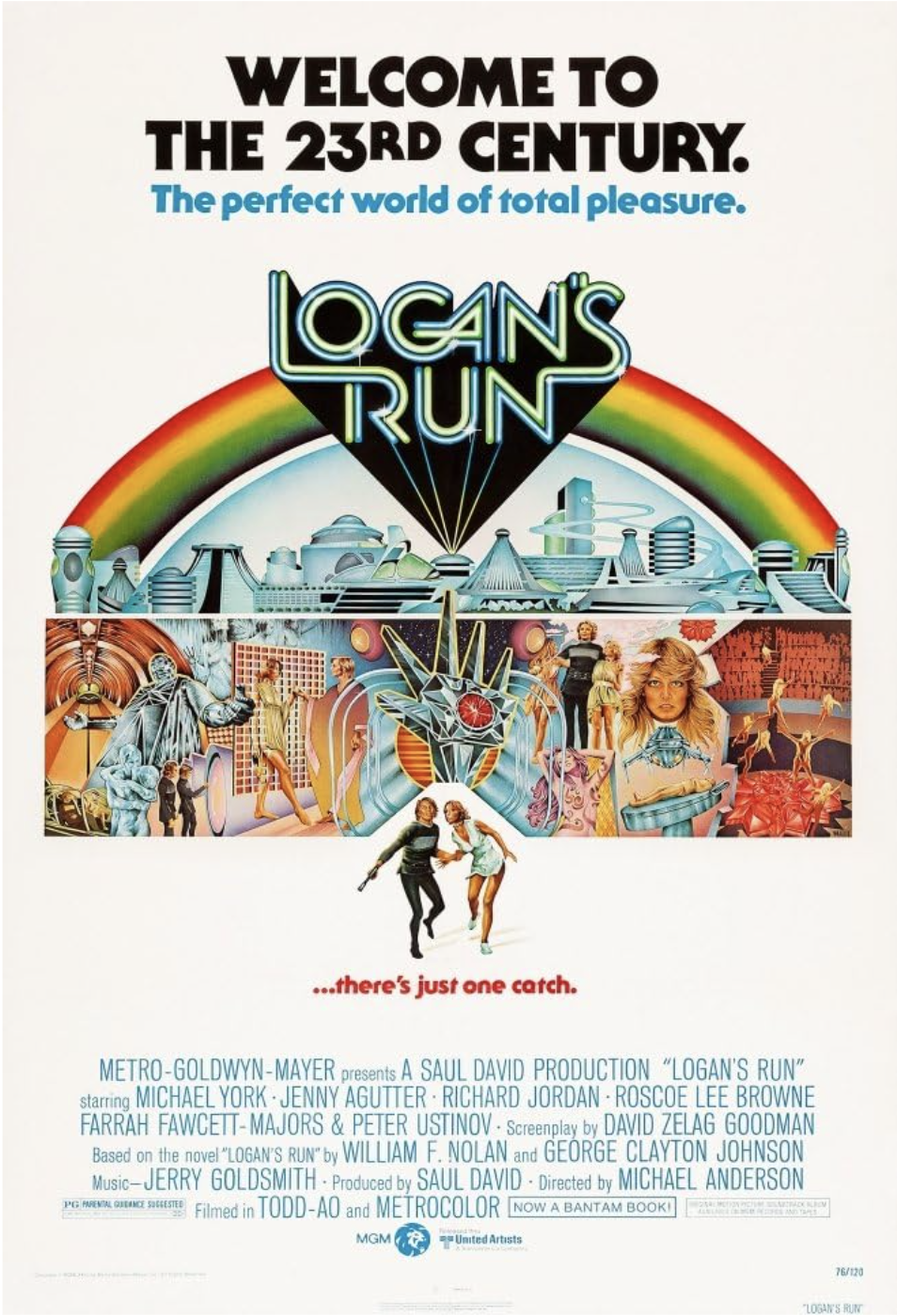
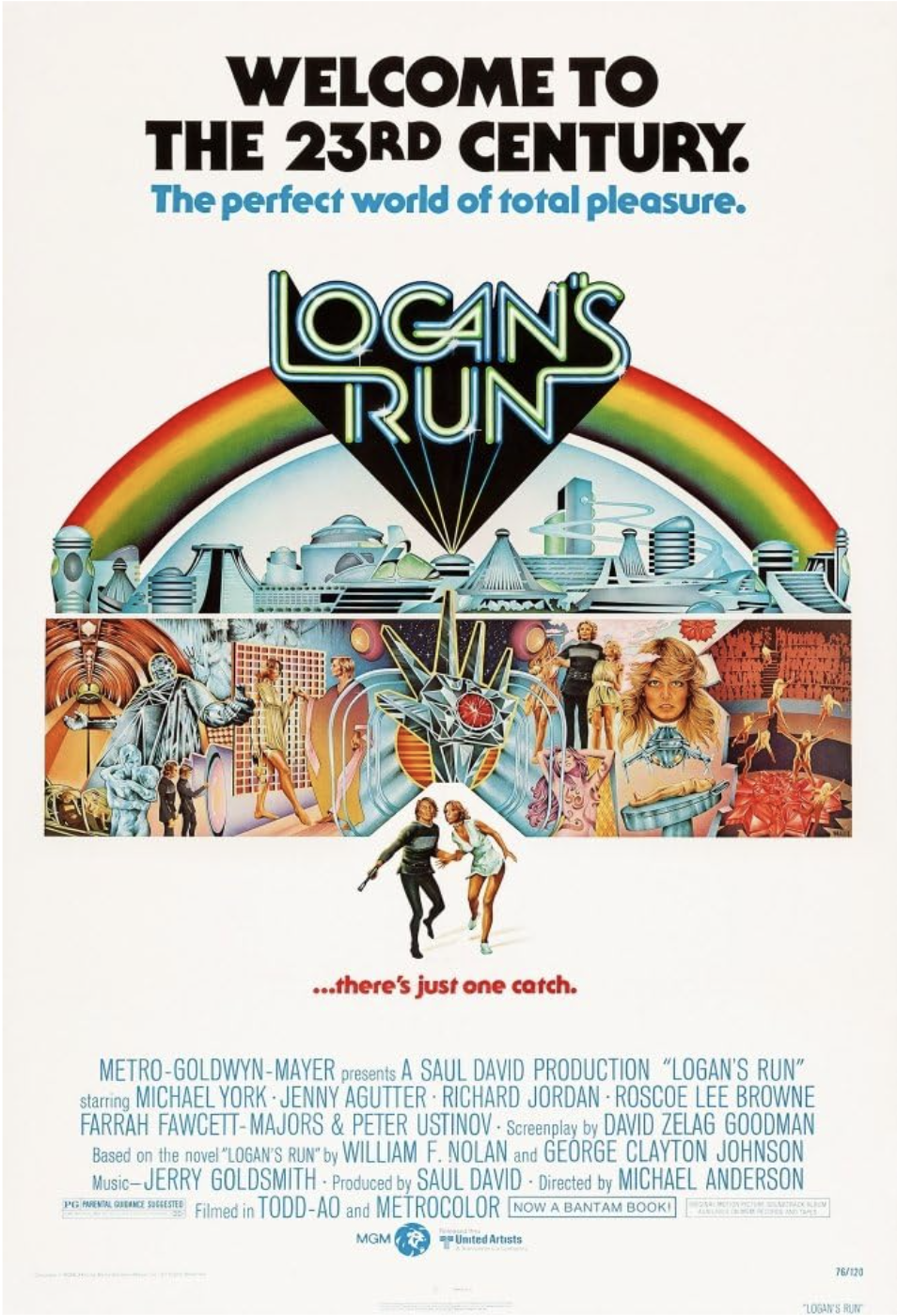
In its premise, Logan’s Run is rather complicated. In the wake of nuclear holocaust, the human race has taken up shelter in a series of sprawling geodesic domes. Humanity has remained tucked away for so long that nobody seems to recall the old world and what might or might not exist beyond the domes. That said, there doesn’t seem much reason to leave. The world of Logan’s Run is “the perfect world of total pleasure” as the movie’s poster declares. Menial tasks are left to machines, everyone appears young and beautiful, and most everything seems free—including love. The poster goes on, “...there’s just one catch.” At the age of thirty, all inhabitants of the domes are forced to enter “Carrousel,” a contest that results in the fiery death of its participants under the promise that they will be reborn. The details of this rebirth aren’t exactly clear, and some inhabitants of the dome have become keen to this. Rather than submit themselves to “Carrousel,” they elect to take their chances as “Runners” instead.
That’s where Logan 5 (Michael York) enters. Logan is a “Sandman,” an elite policeman who specializes in terminating these fugitives called “Runners.” Now, he’s been tasked with going undercover as one and destroying “Sanctuary,” the promised haven for all those who seek escape from “Carrousel.”
In narrative and form, Logan’s Run is paradoxically of and ahead of its time. The sets and costumes ooze ‘70s retro-futurism. The acting is melodramatic, and the second half of the film is a clear pastiche of Planet of the Apes, the smash science-fiction hit of the decade prior. The interior dome scenes are more believable as the inside of a shopping mall than they are the city of tomorrow—which makes sense, since they were shot at Texas’ Dallas Market Center. One could almost imagine Chantal Montellier’s graphic novella Shelter—in which a population sealed by nuclear blast into a subterranean shopping mall reorganizes into a police state—as the origin of the cities depicted in Logan’s Run. Whether intentional or not, this blatantly commercial setting strengthens the film’s case for relevance today. What sets Logan’s Run apart from its peers is that its dystopia is one of abundance rather than scarcity. Its focus on excess seems a far more accurate prediction of where capitalism leads than, say, The Hunger Games (sorry), or even its ‘70s contemporaries like Soylent Green.
In its setting, Logan’s Run anticipates the increasingly homogenized strip-mall landscapes of America today. It also foretells the emergence of dating apps. Here, Tinder is imagined as “The Circuit,” a matter transporter that brings consenting sex partners directly into your home. It even includes the ability to swipe left. As a gay man arrives at Logan’s apartment via “The Circuit,” Logan shakes his head, pushes a button, and the man dematerializes instantaneously. Jessica 6 (Jenny Agutter) enters into Logan’s life in the same way. She’s wired herself through “The Circuit” as a distraction from a friend’s apparent death in a recent “Carrousel.” Her refusal to have sex with Logan upon learning he’s a “Sandman” evokes the image of Harris supporters unmatching when they realize the guy they’ve swiped right on is MAGA today. As Logan goes undercover to destroy “Sanctuary,” Jessica becomes his connection to the world of “Runners” and the gateway to his Orwellian awakening.
While the portrayal of sex in the film remains timely, it was likely written then in response to the free love movement of the ‘60s and ‘70s. In one vignette of their adventure, Logan and Jessica are pursued by “Sandmen” through a “Love Shop.” What they come across inside is less an orgy than it is a tangled mass of limbs—a gyrating wall of flesh grasping at anything that passes through. Other emergent aspects of ‘70s culture, now commonplace, appear in the film as twisted, nightmarish versions of themselves. A preceding chapter of their journey depicts Logan and Jessica facing off against an evil plastic surgeon. He promises to make Logan into a new man with cutting-edge tools and then attempts to kill him with the very same technology. These episodic confrontations gradually reveal the dark underbelly of modernity to the audience. Showcasing lust, sloth, pride, and wrath, they become distinct circles of hell that Logan must pass through.
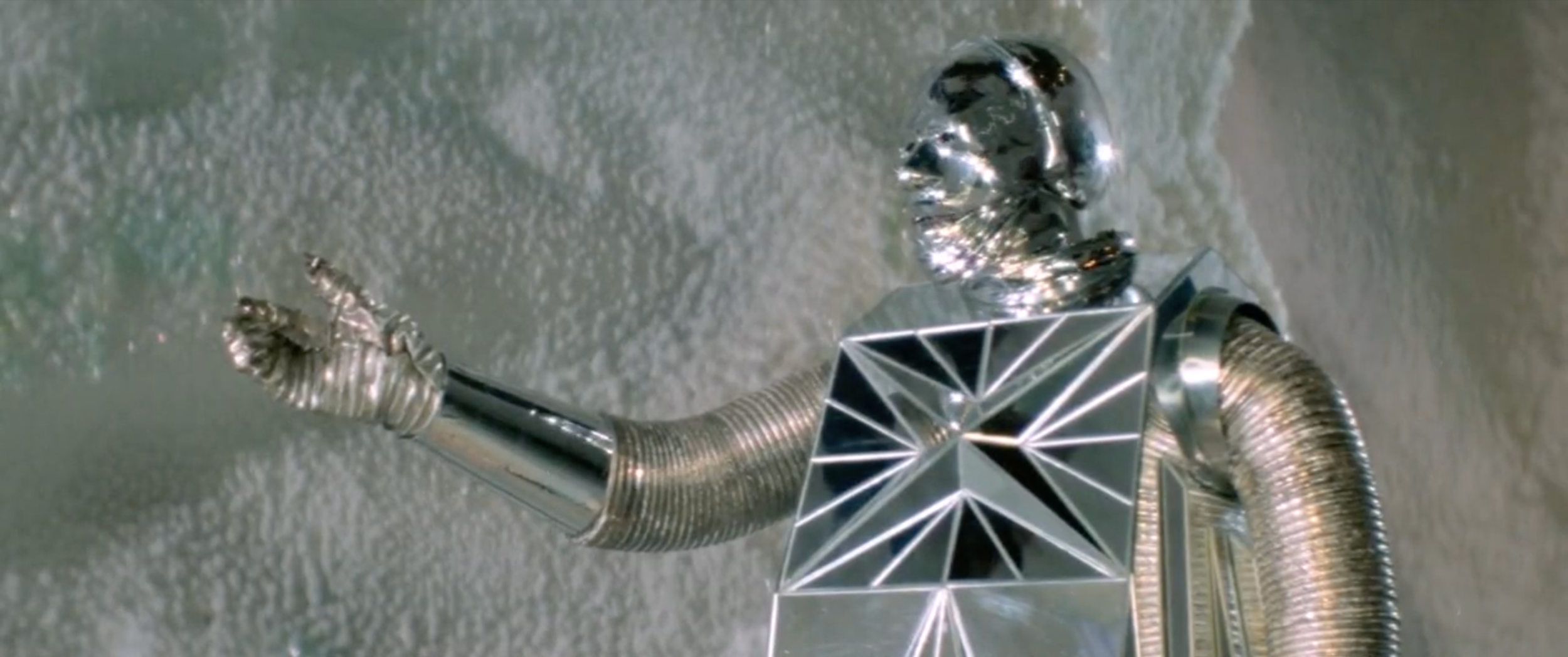
Together, Logan and Jessica reach the final barrier to the outside world. Here, in a garden made of ice (recalling the frozen lake of Dante’s ninth circle), the pair strip naked, revealing themselves as a new-age Adam and Eve. Just as the first couple learns of their nakedness before being cast out of paradise, Logan and Jessica discard their fashions before escaping from hell. They must first, however, contend with Satan. The warden of this place is a cybernetic being called Box (Roscoe Lee Browne), and like Lucifer, Box was created to serve humanity but has since fallen. His frozen layer was once intended to preserve food for the people of the domed cities, further rendering it as a kind of garden. But as Box explains, the food eventually stopped coming and then “Runners” started coming. Mistaking these people for food, Box has encased all the “Runners” who preceded Logan and Jessica in ice. Quite literally, humanity's future has been kept frozen in place. And in seeking to build an artificial paradise, humanity has actually condemned itself to hell.
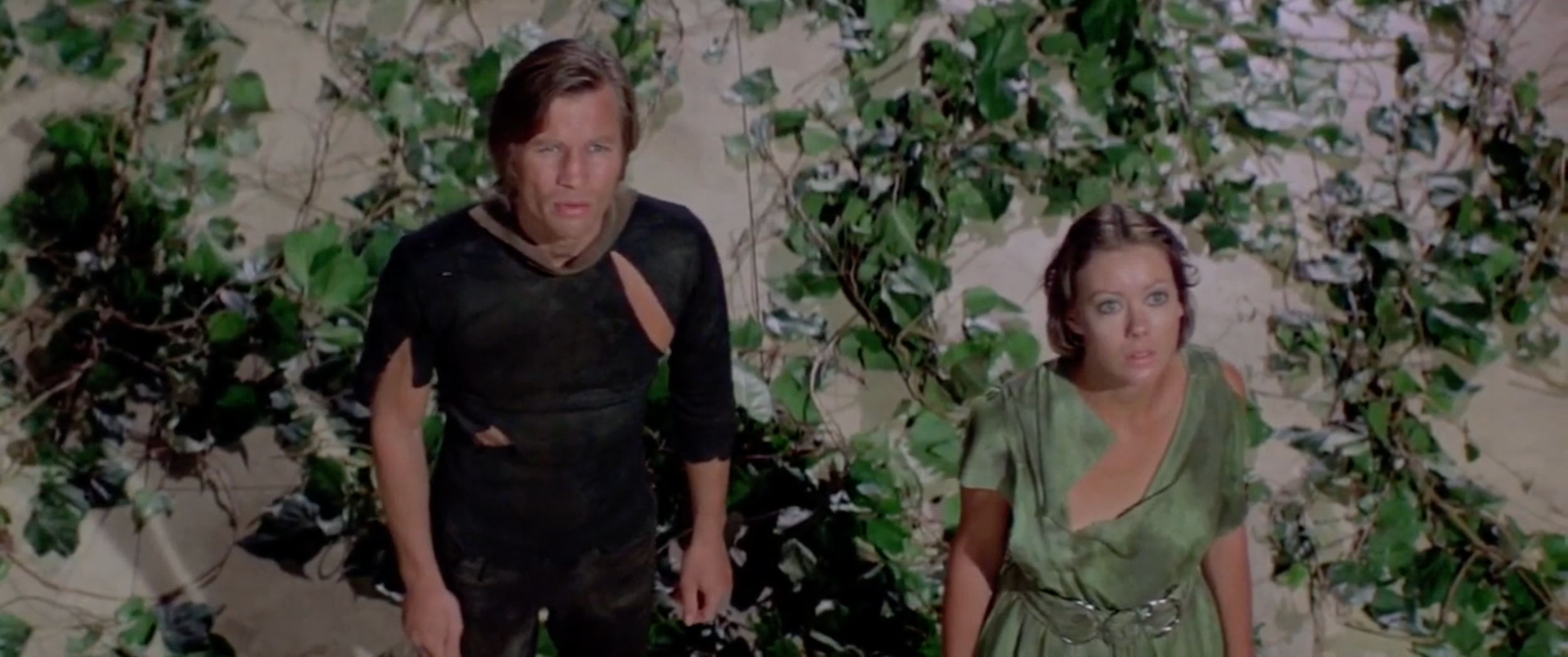
These kinds of biblical inversions are not foreign to science-fiction on screen; the seed for them was planted back in 1927 with Fritz Lang’s Metropolis. It is Logan’s Run, however, that revitalizes this idea for the ‘70s and the decades to come. Just two years later, Battlestar Galactica would feature an android antagonist simply named “Lucifer”—why not call a spade a spade? And 1979’s The Black Hole results in a conclusion of such biblical proportions that its antagonist winds up in what appears to be actual Christian hell. As punishment for his sins, he is bound to his robot servant Maximilian and cast into eternal hellfire. A few years later, the final act of The Empire Strikes Back would use set design to reveal Cloud City—a supposed safe haven—as a mechanical underworld. The duel there between son and cybernetic father culminates with Luke plunging into an abyss, symbolically crossing back from the realm of the dead. This recurring motif of half-man, half-machine evil in science fiction traces back to Logan’s Run, Box, and his frozen garden. It’s no mistake that a machine is chosen here to represent the ultimate avatar of evil: Logan’s Run is explicitly Luddite in its philosophy. As Logan defeats Box and takes his first steps beyond the dome, the natural world is unveiled as the true “Sanctuary.” Jessica and Logan’s first sight is a sunrise, its meaning unmistakable: for the first time, a new day dawns on humanity. The ice of Box’s garden melts beneath the sun, pouring down in a deluge across the rugged cliffs where Logan and Jessica now stand. Humanity’s future has at last become unfrozen.
In 1976, with the release of Logan’s Run, the genre of science-fiction was also beginning to thaw. The preceding decades had been dominated by cold and calculating pictures; their leading men—with a select few exceptions—were rigid and emotionally distant. While Logan starts the film out this way, York brings a tenderness to the character by the time the credits roll. Though his performance and those of the ensemble are undeniably full of camp, they are also full of heart, which the genre desperately needed at the time. While Logan was still a ways away from the whiny, boyish protagonist of Star Wars a year later, he signaled an important sea change. For all of its complexity, the greatest strength of Logan’s Run isn’t in its plot but rather in its characters. The ‘50s and ‘60s had been mired by sci-fi B-movies that sold on premise alone. When audiences actually sat down in theaters to discover that the headlining “Invaders from Mars” or “It from Outer Space” only appeared for a couple of minutes, they were understandably disappointed. Had these films taken the time to develop the characters that fill their runtime in the way Logan’s Run does, things might have been different.
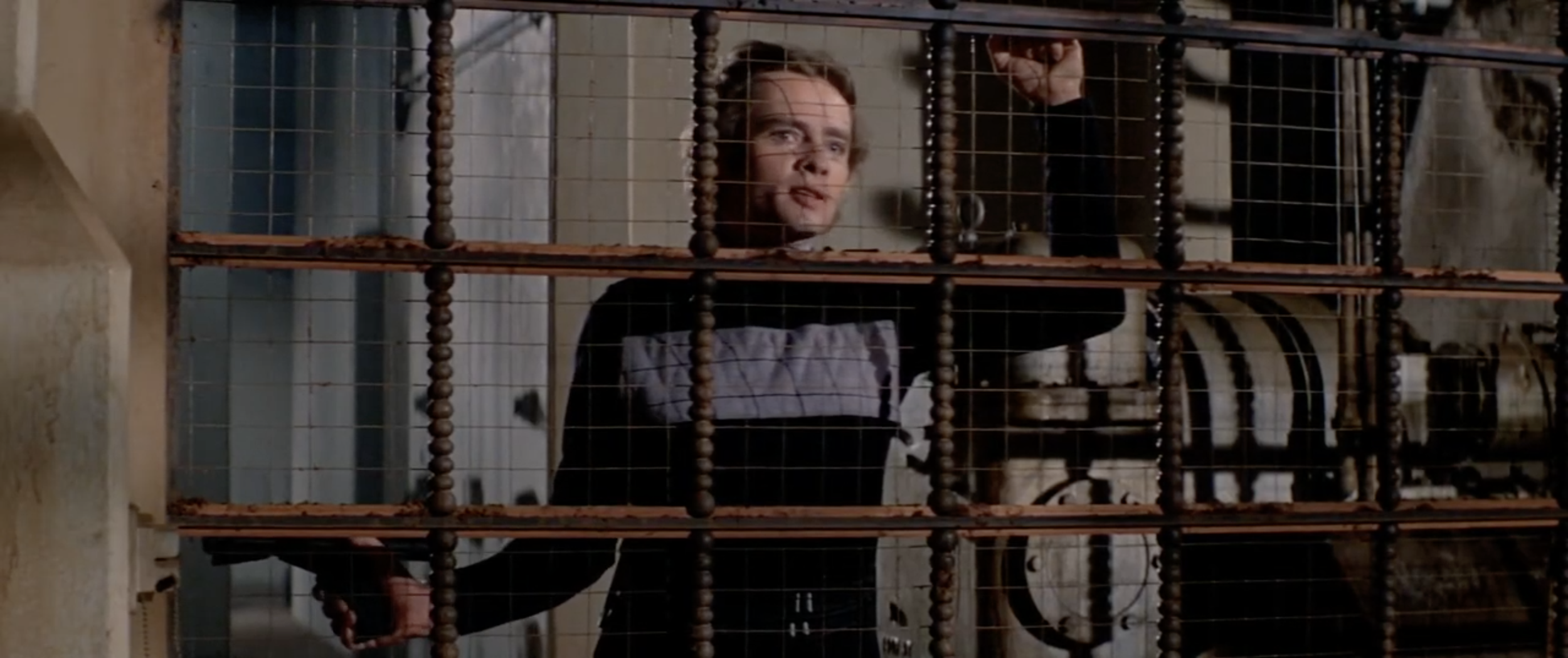
The emotional heart of Logan’s Run comes from the decaying friendship of its lead character and Francis 7, a fellow “Sandman” played by Richard Jordan—one of the most criminally undervalued actors of the ‘70s. As Logan is deradicalized, Francis remains unquestioning and steadfast in his belief. He pursues Logan and Jessica relentlessly, even beyond the domed cities. Their final confrontation is inevitable. In the ruins of the United States Senate Chamber, Logan and Francis fight to the death. If the metaphor wasn’t heavy-handed enough, Francis takes up a tattered American flag, brandishing it as a weapon. Three decades later, George Lucas would conclude his Star Wars saga with a similar battle between brothers, intercut with the destruction of a senate chamber.
Logan’s Run, in the wake of Logan and Francis’ duel, concludes with its protagonists returning to the place where their journey began. Dirty and worn, they try to tell the people of their former society the truth: they can live freely beyond the age of thirty in the outside world. But to their eyes, Logan and Jessica appear like madmen, and nobody cares. Human apathy is the perfect prison. It keeps the masses complacent and discards those who challenge the status-quo as conspiracy theorists and delusional outsiders. “Sandmen” arrive to detain Logan and he’s interrogated by the city’s computer, an advanced AI that orchestrates life in the domed cities. Its destruction sets off a chain reaction that dismantles the domes, exposing the population to the outside world. As Box’s demise first signaled hope for humanity, the death of the computer delivers on this in full. At last, the veil of hedonistic contentment has been lifted. With the death of the computer, life goes on.
- Matt
LOGAN’S RUN
Directed by Michael Anderson
1976 | 118 min
“OVERWHELMING, AM I NOT?”
I was twelve years old when I first came across Logan’s Run. At the time, movies weren’t of much interest to me; I spent most of my free time doodling cartoons and illustrating my own comics. Of these, my favorite to draw were the misadventures of Major Tom, named after David Bowie’s character from the song “Space Oddity.” Only, my version of the character had terribly little to do with Bowie’s and was really a thinly veiled rip-off of Futurama’s Zapp Brannigan. In one particular installment—where Tom attended a costume party—I needed to find the perfect outfit for him. It had to be some obscure nod to science fiction, exactly the kind of thing my version of Tom would pride himself on.
For a handful of hours, I combed through ‘60s and ‘70s sci-fi movie trailers on YouTube in search of the perfect fit. Then at last: Logan’s Run. Now, while I wasn’t much of a film buff at the time, what I certainly was passionate about was Star Wars. So, when I saw Logan’s laser-gun and a villainous robot in the trailer, that was more than enough to get me on board. Major Tom ended up attending the party in Logan’s distinctive uniform and my comic got a few laughs from my brother (which just so happened to account for the entirety of my readership). Pretty quickly, Logan’s Run turned into something of an in-joke between the two of us.
It wasn’t until a year later that I watched Logan’s Run for the first time. For my thirteenth birthday, my brother got me the movie on DVD. One night, when it was just the two of us at home, we jammed Logan’s into our Lightning McQueen-shaped portable DVD player and watched it over our chicken finger dinner.
I didn’t like it very much.
But the next day, I was strangely compelled to watch the movie again. Then again the following day. And again the day after that. Within a week of first having watched the film, I’d rewatched Logan’s Run about four or five times. Skip ahead to today and I’ve seen about 1,600 films and can still count on one hand the number that have had that effect on me. But Logan’s Run was first. As a thirteen-year-old, I was more than familiar with Star Wars, Spider-Man, and Indiana Jones, but this was something new. Here was a movie that nobody had ever spoken to me about, and one that I had discovered for myself. It was a stepping stone into a wider world of film, toward thousands of other movies that no one ever mentioned, yet were still waiting out there to be discovered nonetheless.
In its premise, Logan’s Run is rather complicated. In the wake of nuclear holocaust, the human race has taken up shelter in a series of sprawling geodesic domes. Humanity has remained tucked away for so long that nobody seems to recall the old world and what might or might not exist beyond the domes. That said, there doesn’t seem much reason to leave. The world of Logan’s Run is “the perfect world of total pleasure” as the movie’s poster declares. Menial tasks are left to machines, everyone appears young and beautiful, and most everything seems free—including love. The poster goes on, “...there’s just one catch.” At the age of thirty, all inhabitants of the domes are forced to enter “Carrousel,” a contest that results in the fiery death of its participants under the promise that they will be reborn. The details of this rebirth aren’t exactly clear, and some inhabitants of the dome have become keen to this. Rather than submit themselves to “Carrousel,” they elect to take their chances as “Runners” instead.
That’s where Logan 5 (Michael York) enters. Logan is a “Sandman,” an elite policeman who specializes in terminating these fugitives called “Runners.” Now, he’s been tasked with going undercover as one and destroying “Sanctuary,” the promised haven for all those who seek escape from “Carrousel.”
In narrative and form, Logan’s Run is paradoxically of and ahead of its time. The sets and costumes ooze ‘70s retro-futurism. The acting is melodramatic, and the second half of the film is a clear pastiche of Planet of the Apes, the smash science-fiction hit of the decade prior. The interior dome scenes are more believable as the inside of a shopping mall than they are the city of tomorrow—which makes sense, since they were shot at Texas’ Dallas Market Center. One could almost imagine Chantal Montellier’s graphic novella Shelter—in which a population sealed by nuclear blast into a subterranean shopping mall reorganizes into a police state—as the origin of the cities depicted in Logan’s Run. Whether intentional or not, this blatantly commercial setting strengthens the film’s case for relevance today. What sets Logan’s Run apart from its peers is that its dystopia is one of abundance rather than scarcity. Its focus on excess seems a far more accurate prediction of where capitalism leads than, say, The Hunger Games (sorry), or even its ‘70s contemporaries like Soylent Green.
In its setting, Logan’s Run anticipates the increasingly homogenized strip-mall landscapes of America today. It also foretells the emergence of dating apps. Here, Tinder is imagined as “The Circuit,” a matter transporter that brings consenting sex partners directly into your home. It even includes the ability to swipe left. As a gay man arrives at Logan’s apartment via “The Circuit,” Logan shakes his head, pushes a button, and the man dematerializes instantaneously. Jessica 6 (Jenny Agutter) enters into Logan’s life in the same way. She’s wired herself through “The Circuit” as a distraction from a friend’s apparent death in a recent “Carrousel.” Her refusal to have sex with Logan upon learning he’s a “Sandman” evokes the image of Harris supporters unmatching when they realize the guy they’ve swiped right on is MAGA today. As Logan goes undercover to destroy “Sanctuary,” Jessica becomes his connection to the world of “Runners” and the gateway to his Orwellian awakening.
While the portrayal of sex in the film remains timely, it was likely written then in response to the free love movement of the ‘60s and ‘70s. In one vignette of their adventure, Logan and Jessica are pursued by “Sandmen” through a “Love Shop.” What they come across inside is less an orgy than it is a tangled mass of limbs—a gyrating wall of flesh grasping at anything that passes through. Other emergent aspects of ‘70s culture, now commonplace, appear in the film as twisted, nightmarish versions of themselves. A preceding chapter of their journey depicts Logan and Jessica facing off against an evil plastic surgeon. He promises to make Logan into a new man with cutting-edge tools and then attempts to kill him with the very same technology. These episodic confrontations gradually reveal the dark underbelly of modernity to the audience. Showcasing lust, sloth, pride, and wrath, they become distinct circles of hell that Logan must pass through.
Together, Logan and Jessica reach the final barrier to the outside world. Here, in a garden made of ice (recalling the frozen lake of Dante’s ninth circle), the pair strip naked, revealing themselves as a new-age Adam and Eve. Just as the first couple learns of their nakedness before being cast out of paradise, Logan and Jessica discard their fashions before escaping from hell. They must first, however, contend with Satan. The warden of this place is a cybernetic being called Box (Roscoe Lee Browne), and like Lucifer, Box was created to serve humanity but has since fallen. His frozen layer was once intended to preserve food for the people of the domed cities, further rendering it as a kind of garden. But as Box explains, the food eventually stopped coming and then “Runners” started coming. Mistaking these people for food, Box has encased all the “Runners” who preceded Logan and Jessica in ice. Quite literally, humanity's future has been kept frozen in place. And in seeking to build an artificial paradise, humanity has actually condemned itself to hell.
These kinds of biblical inversions are not foreign to science-fiction on screen; the seed for them was planted back in 1927 with Fritz Lang’s Metropolis. It is Logan’s Run, however, that revitalizes this idea for the ‘70s and the decades to come. Just two years later, Battlestar Galactica would feature an android antagonist simply named “Lucifer”—why not call a spade a spade? And 1979’s The Black Hole results in a conclusion of such biblical proportions that its antagonist winds up in what appears to be actual Christian hell. As punishment for his sins, he is bound to his robot servant Maximilian and cast into eternal hellfire. A few years later, the final act of The Empire Strikes Back would use set design to reveal Cloud City—a supposed safe haven—as a mechanical underworld. The duel there between son and cybernetic father culminates with Luke plunging into an abyss, symbolically crossing back from the realm of the dead. This recurring motif of half-man, half-machine evil in science fiction traces back to Logan’s Run, Box, and his frozen garden. It’s no mistake that a machine is chosen here to represent the ultimate avatar of evil: Logan’s Run is explicitly Luddite in its philosophy. As Logan defeats Box and takes his first steps beyond the dome, the natural world is unveiled as the true “Sanctuary.” Jessica and Logan’s first sight is a sunrise, its meaning unmistakable: for the first time, a new day dawns on humanity. The ice of Box’s garden melts beneath the sun, pouring down in a deluge across the rugged cliffs where Logan and Jessica now stand. Humanity’s future has at last become unfrozen.
In 1976, with the release of Logan’s Run, the genre of science-fiction was also beginning to thaw. The preceding decades had been dominated by cold and calculating pictures; their leading men—with a select few exceptions—were rigid and emotionally distant. While Logan starts the film out this way, York brings a tenderness to the character by the time the credits roll. Though his performance and those of the ensemble are undeniably full of camp, they are also full of heart, which the genre desperately needed at the time. While Logan was still a ways away from the whiny, boyish protagonist of Star Wars a year later, he signaled an important sea change. For all of its complexity, the greatest strength of Logan’s Run isn’t in its plot but rather in its characters. The ‘50s and ‘60s had been mired by sci-fi B-movies that sold on premise alone. When audiences actually sat down in theaters to discover that the headlining “Invaders from Mars” or “It from Outer Space” only appeared for a couple of minutes, they were understandably disappointed. Had these films taken the time to develop the characters that fill their runtime in the way Logan’s Run does, things might have been different.
The emotional heart of Logan’s Run comes from the decaying friendship of its lead character and Francis 7, a fellow “Sandman” played by Richard Jordan—one of the most criminally undervalued actors of the ‘70s. As Logan is deradicalized, Francis remains unquestioning and steadfast in his belief. He pursues Logan and Jessica relentlessly, even beyond the domed cities. Their final confrontation is inevitable. In the ruins of the United States Senate Chamber, Logan and Francis fight to the death. If the metaphor wasn’t heavy-handed enough, Francis takes up a tattered American flag, brandishing it as a weapon. Three decades later, George Lucas would conclude his Star Wars saga with a similar battle between brothers, intercut with the destruction of a senate chamber.
Logan’s Run, in the wake of Logan and Francis’ duel, concludes with its protagonists returning to the place where their journey began. Dirty and worn, they try to tell the people of their former society the truth: they can live freely beyond the age of thirty in the outside world. But to their eyes, Logan and Jessica appear like madmen, and nobody cares. Human apathy is the perfect prison. It keeps the masses complacent and discards those who challenge the status-quo as conspiracy theorists and delusional outsiders. “Sandmen” arrive to detain Logan and he’s interrogated by the city’s computer, an advanced AI that orchestrates life in the domed cities. Its destruction sets off a chain reaction that dismantles the domes, exposing the population to the outside world. As Box’s demise first signaled hope for humanity, the death of the computer delivers on this in full. At last, the veil of hedonistic contentment has been lifted. With the death of the computer, life goes on.
- Matt
